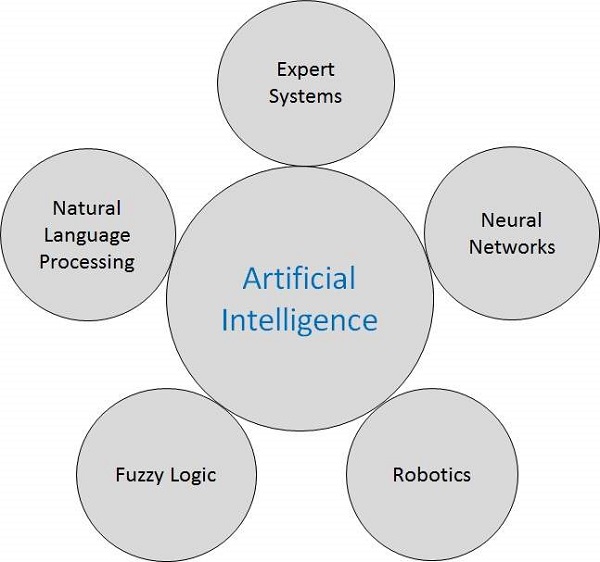
artificial intelligence research addresses the central challenges of machine cognition, both from a theoretical perspective and from an empirical, implementation-oriented perspective.
Work in Artificial Intelligence research in core areas of knowledge representation, reasoning, learning, planning, decision-making, vision, robotics, speech and language processing. There are also significant efforts aimed at applying algorithmic advances to applied problems in a range of areas, including bioinformatics, networking and systems, search and information retrieval. This area also involves techniques and tools from statistics, neuroscience, control, optimization, and operations research.
Topics:
- Automatic Programming
- Generic Programs, Partial Evaluation, Design Representation, Inference, Programming Interfaces.
- Automated Reasoning and Interactive Theorem Proving
- Simplification; Induction; Concept-formation; Lemma discovery; User interfaces; Hardware and software modeling and verification.
- Autonomous Agents
- Learning agents; Bidding agents; Robots; Game AI.
- Computer Vision
- Object and activity recognition; Content-based retrieval; Learning and vision; Robot vision; Biologically inspired vision.
- Data Mining
- Database search and mining; Large-scale data analysis; Social network analysis; Network estimation.
- Knowledge Representation and Reasoning
- Knowledge representation languages: Description logic, frames, graphical representations; Knowledge content areas: Temporal, Spatial, Causal knowledge; Ontology; Semantic matching; Constraint satisfaction; Expert systems; Semantic web; Cognitive modeling: memory models; Belief revision and truth maintenance.
- Learning Theory
- Computational and statistical analysis of learning algorithms; Online learning; Active learning; Probabilistic inference.
- Logic-based AI
- Commonsense knowledge; Reasoning about actions; Nonmonotonic reasoning; Answer set programming.
- Machine Learning
- Supervised learning; Reinforcement learning; Transfer learning; Active learning; Optimization; Graphical models; Nonparametric models; Probabilistic inference; Deep Learning.
- Multiagent Systems
- Multiagent learning; Multirobot systems; Game theory.
- Natural Computation
- Neural networks; Evolutionary computation; Computational neuroscience; Cognitive science.
- Natual Language Processing
- Syntactic parsing; Semantic analysis; Information extraction; Grounded language; Question answering; Dialog systems.
- AI Applications
- Autonomous driving; Robot soccer; Question answering; Math and Physics Problem Solving; Nonlinear control; Game playing; Fraud detection.
Learning and Probabilistic Inference:
Graphical models. Kernel methods. Nonparametric Bayesian methods. Reinforcement learning. Problem solving, decisions, and games.Search and Information Retrieval:
Collaborative filtering. Information extraction. Image and video search. Intelligent information systems.Speech and Language:
Parsing. Machine translation. Speech Recognition. Context Modeling. Dialog Systems.Vision:
Object Recognition. Scene Understanding. Human Activity Recognition. Active Vision. Grouping and Figure-Ground. Visual Data Mining.Robotics:
Motion Planning, Computational Geometry. Computer assisted surgical and medical analysis, planning, and monitoring. Unmanned Air Vehicles
